Most men over 40 don’t think twice about sitting for eight, ten, or twelve hours a day. Between desk jobs, commutes, and evening screen time, prolonged sitting has become the default mode of modern life. What fewer men realize is that this habit quietly stacks risk against three of the most common prostate conditions: prostate cancer, benign prostatic hyperplasia (BPH), and prostatitis.
This guide breaks down exactly how a sedentary lifestyle affects prostate health, what the research actually says, including some findings that contradict the mainstream narrative, and what practical steps can meaningfully reduce your risk.
How Sitting Affects the Prostate: The Biological Mechanisms
Understanding why sitting damages prostate health means looking at what happens inside the body during prolonged inactivity, not just the statistical associations.
Insulin Resistance and Chronic Inflammation
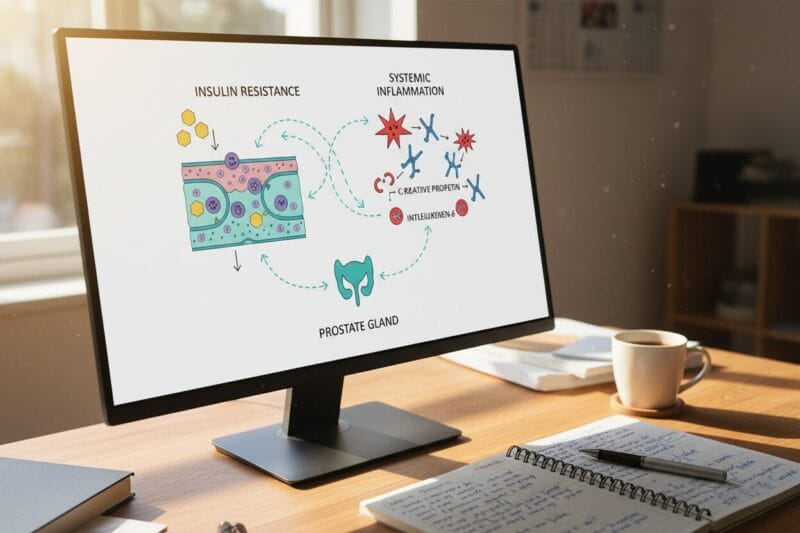
When you sit for extended periods, your muscles stop contracting and glucose uptake slows dramatically. This contributes to insulin resistance, a state where cells stop responding efficiently to insulin. Elevated insulin and insulin-like growth factor (IGF-1) have been directly linked to accelerated cell proliferation in prostate tissue, raising the risk of both benign enlargement and malignant transformation.
Chronic low-grade inflammation is a second pathway. Sedentary behavior elevates systemic inflammatory markers, including C-reactive protein (CRP) and interleukin-6 (IL-6). Prostate tissue is particularly sensitive to inflammatory signaling, and persistent inflammation creates an environment that can accelerate BPH progression and increase susceptibility to prostatitis.
Androgen Hormone Disruption
Physical inactivity also disrupts the balance of androgens, specifically testosterone and dihydrotestosterone (DHT). DHT is the primary driver of prostate cell growth, and sedentary men tend to have higher circulating estrogen relative to testosterone due to increased body fat. This hormonal imbalance promotes prostate tissue growth and contributes to BPH development over time.
Direct Perineal Pressure
There is also a straightforward mechanical explanation. The prostate gland sits just below the bladder and in front of the rectum, directly in the path of pressure exerted when a man sits. Prolonged compression of the perineum restricts blood flow to the prostate, causes localized tissue irritation, and can trigger or worsen prostatitis. As urologists cited in US News Health have noted, prolonged sitting can directly irritate the prostate gland, with prostatitis being a recognized consequence of this sustained pressure.
Sedentary Behavior and Prostate Cancer Risk
The relationship between sitting time and prostate cancer is one of the most studied, and most nuanced, areas in men’s urological health.
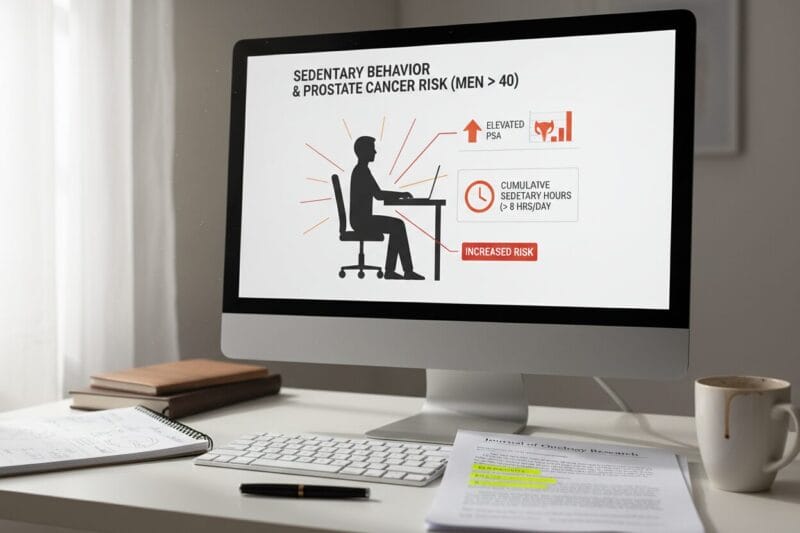
Data from the NIH-AARP Diet and Health Study found that men whose lifetime occupation involved mostly sitting had a 27% increased risk of prostate cancer compared to men in more physically active roles. A separate finding showed that men with an extra hour of sedentary time per day had a 16% greater chance of having elevated PSA levels, a key prostate cancer biomarker. PSA elevation is not a diagnosis, but it is a measurable early warning signal that something in the prostate environment is being disrupted.
Research published in PMC (6198967) further confirmed that prolonged sitting and low physical activity are independently associated with prostate cancer risk, alongside colorectal and lung cancers. Sitting is not creating a localized prostate problem in isolation; it is creating a body-wide environment that favors cancer development.
What the Contradictory ASCO Data Actually Means
Here is where the science gets more complicated, and where most articles fall short. A 2021 ASCO study found that patients with sedentary occupations presenting for prostate biopsy were actually at a lower apparent risk for a positive biopsy result. The European Journal of Cancer Prevention similarly noted that the association between sedentary time and incident prostate cancer is unclear, with at least one study showing no association with total sitting time.
How do you reconcile these findings? The key is understanding what is being measured. Elevated PSA and epidemiological cancer associations reflect biological stress signals and population-level trends. Biopsy-confirmed cancer is a different, more definitive endpoint. Men in sedentary occupations may also be screened more regularly, or have other lifestyle characteristics that confound the data.
The honest takeaway: chronic inactivity creates biological conditions unfavorable for prostate health, but sitting alone is unlikely to be the sole determinant of whether a biopsy comes back positive. The risk is real, cumulative, and modifiable.
BPH: How Inactivity Enlarges the Prostate
Benign prostatic hyperplasia affects more than 50% of men by age 60 and over 80% by age 80. While aging is the primary driver, physical inactivity accelerates the hormonal and metabolic changes that promote prostate tissue growth.
Harvard Health Publishing summarized the current evidence clearly: “Emerging scientific evidence suggests that engaging in a few hours of exercise a week may help keep prostate enlargement in check.” That framing is conservative but significant. It means exercise has a direct, measurable effect on prostate tissue behavior, not just on cardiovascular health or weight management.
The sympathetic nervous system plays a specific role here that most articles overlook. Sedentary men have chronically elevated sympathetic tone, which increases smooth muscle tension in the bladder neck and prostate. This worsens urinary obstruction symptoms in men with BPH, even when prostate size itself has not changed dramatically. Exercise reduces sympathetic tone, which is why physically active men with BPH often report better urinary flow than sedentary men with similarly sized prostates.
Obesity, which closely correlates with sedentary behavior, further compounds BPH risk. Adipose tissue converts androgens to estrogens, and higher estrogen levels in men stimulate prostate stromal cell proliferation. Losing even 5 to 10% of body weight through increased physical activity can measurably reduce BPH symptom severity.
Prostatitis: When Sitting Becomes the Direct Trigger
Prostatitis is inflammation of the prostate gland, and it is the most directly mechanical of the three conditions linked to sitting. Chronic non-bacterial prostatitis, also called chronic pelvic pain syndrome, is the most common form and the one most strongly linked to sedentary behavior. Unlike bacterial prostatitis, which requires antibiotic treatment, non-bacterial prostatitis is heavily influenced by lifestyle factors including sustained perineal compression, pelvic floor muscle tension, and poor pelvic circulation.
Ergonomic Interventions That Actually Help
The good news is that prostatitis triggered by sitting responds well to environmental changes. Several specific modifications have evidence behind them:
Ergonomic cutout chairs: Seats with a central cutout or perineal relief channel reduce direct pressure on the prostate and perineal nerve bundle. Cyclists and men with desk jobs who use these chairs report meaningful reductions in pelvic discomfort.
Standing desk intervals: Alternating between sitting and standing every 30 to 45 minutes breaks the cycle of sustained perineal compression without requiring any formal exercise.
Cushion support: A donut-shaped or coccyx-relief cushion redistributes body weight away from the perineum, providing relief during long driving or desk sessions.
These ergonomic solutions do not replace movement, but they meaningfully reduce the direct mechanical stress that sitting places on prostate tissue.
Lower Urinary Tract Symptoms: The Underrecognized Consequence
Lower urinary tract symptoms (LUTS) include frequent urination, weak stream, urgency, incomplete emptying, and nocturia. They are often discussed as a downstream consequence of BPH or prostatitis, but research shows that prolonged sitting time and low physical activity independently raise the risk of developing LUTS, separate from any specific prostate diagnosis.
This distinction matters because it means men without a formal prostate diagnosis can still develop significant urinary problems from sedentary behavior alone. The same research found that minimally active men had lower LUTS risk compared to completely inactive men. You do not need to run marathons; even modest increases in daily movement produce measurable protection against urinary symptom development.
If you regularly experience any of the following, your sitting habits may be contributing:
- Needing to urinate more than eight times in 24 hours
- A weak or interrupted urine stream
- A sense of urgency that is difficult to defer
- Waking more than once per night to urinate
- A feeling of incomplete bladder emptying after urinating
These symptoms warrant a conversation with a urologist, but reducing daily sitting time is a reasonable first step regardless of what the clinical evaluation shows.

Occupational Sitting vs. Leisure Sitting: A Distinction That Changes What You Can Do
Not all sedentary time carries equal weight, and this distinction is highly actionable. Occupational sitting is largely non-negotiable for desk workers, drivers, and office professionals. Leisure sitting, by contrast, is a choice. Research from the European Journal of Cancer Prevention specifically examined leisure-time sitting as a distinct variable, separate from work-related inactivity.
This matters practically because it shifts the intervention target. If you cannot change your job, you can change what happens outside of work hours. Replacing two hours of evening television with a walk, a gym session, or even light household activity meaningfully changes your overall sedentary profile. The biological systems that create prostate risk, including insulin sensitivity, inflammatory markers, and sympathetic nervous system tone, respond to cumulative daily movement, not just structured exercise.
A reasonable framework for men who cannot avoid occupational sitting:
- Take a 5-minute standing or walking break every 45 to 60 minutes during the workday.
- Replace at least 60 minutes of leisure screen time per day with moderate physical activity.
- Aim for 150 minutes of moderate aerobic exercise per week, the threshold supported by most prostate health research.
- Add two sessions of resistance training per week to improve insulin sensitivity and hormonal balance.
- Include pelvic floor exercises three times per week to improve pelvic circulation and reduce LUTS severity.
What Exercise Type Works Best for Prostate Health
“Exercise more” is advice that appears in nearly every article on this topic without any specificity. The evidence actually points to a more nuanced picture.
Aerobic exercise: Brisk walking, cycling, and swimming are the most consistently supported activities for reducing prostate cancer risk and BPH symptom severity. Walking at a moderate pace for 30 minutes, five days a week, falls within the protective threshold identified in multiple studies. For men already managing BPH, aerobic activity reduces sympathetic nervous system activation and improves urinary flow metrics within weeks.
Resistance training: Compound movements like squats, deadlifts, and rows improve insulin sensitivity and modulate testosterone-to-estrogen ratios, addressing two of the core hormonal pathways linking sedentary behavior to prostate problems. Two sessions per week provide sufficient stimulus without overloading recovery.
Pelvic floor exercises: Specifically relevant for men with prostatitis or LUTS, strengthening the pelvic floor improves blood flow to the pelvic region, reduces muscle tension contributing to chronic pelvic pain, and can improve urinary control. The technique involves contracting the muscles used to stop urination, holding for 5 seconds, and releasing; 10 to 15 repetitions three times daily is the standard starting point.
One important caveat: prolonged cycling on a narrow saddle can actually worsen perineal pressure and prostatitis symptoms. Men who cycle regularly should use a saddle with a central cutout and limit sessions to under 60 minutes without a break.
Putting It Together: A Practical Action Plan
The research is consistent enough to support a clear, tiered approach. Small, consistent changes compound over months and years into meaningful risk reduction.
Priority 1: Break up sitting time. Set a timer for every 45 minutes during your workday and stand or walk for 5 minutes. This alone begins to reduce the sustained perineal pressure and metabolic stagnation that sitting creates.
Priority 2: Hit the 150-minute weekly aerobic threshold. This is the minimum effective dose supported by the available evidence. Walking counts. Swimming counts. Cycling counts, with the saddle caveat noted above.
Priority 3: Address your leisure sitting. Audit your evening and weekend habits. Even replacing one hour of passive screen time with movement has measurable effects on the metabolic and hormonal pathways linked to prostate risk.
Priority 4: Get screened appropriately. If you are over 50, or over 40 with a family history of prostate cancer, regular PSA testing gives you a quantifiable measure of how your prostate is responding to your lifestyle. Elevated PSA is not a verdict; it is data.
For men exploring supportive supplements as part of a broader prostate health strategy, our [comprehensive prostate supplement review][HUB_URL] covers what the evidence actually supports and what to look for on the label.

Prostate problems are not inevitable consequences of aging. In significant part, they are consequences of how modern men spend their hours. The sedentary lifestyle that most workplaces and entertainment habits encourage creates a sustained biological environment that the prostate is poorly equipped to tolerate. The interventions are not complicated, but they do require consistency. Moving more, sitting less, and paying attention to the body’s early warning signals is a strategy backed by solid evidence and accessible to almost every man.